Wednesday, 4 June 2008

Twinkle twinkle little Star

Back when people used to look up at the sky and wonder what all those lights in the sky were, back when so little was known about the processes by which the cosmos is lit, and by which almost everything we are was created... back then eh!

Nowadays we know that those lights in the sky are in fact massive balls of gas, converting hydrogen into helium at their cores though a process of nuclear fusion. Of course this is just a simplistic description of your standard main sequence star, there are many many other stages of stellar evolution, and indeed types of star.

The point is that we now know this. Through a multitude of methods we can determine the composition, size and distance of those stars that we see. They are no longer unfathomable objects in the sky.

That said, nothing beats a close up look. Most of the time stars other than our Sun are mere points of light. However, one of the better known beasties, Betelgeuse, is both large enough (absolutely freakin' huge) and close enough for surface features to be resolved.

So having read through all that, i'd like to direct you to this short article from the Cavendish Astrophysics website where you can read up on the imaging methods used to obtain the pictures of the stellar disk in question. The images don't show much detail - but you have to remember that this object is 430 lightyears away. Thats 27 million times the distance from the Earth to the Sun, so you can forgive it for not looking quite as impressive!

Wednesday, 28 May 2008

HiRISE is awesome.

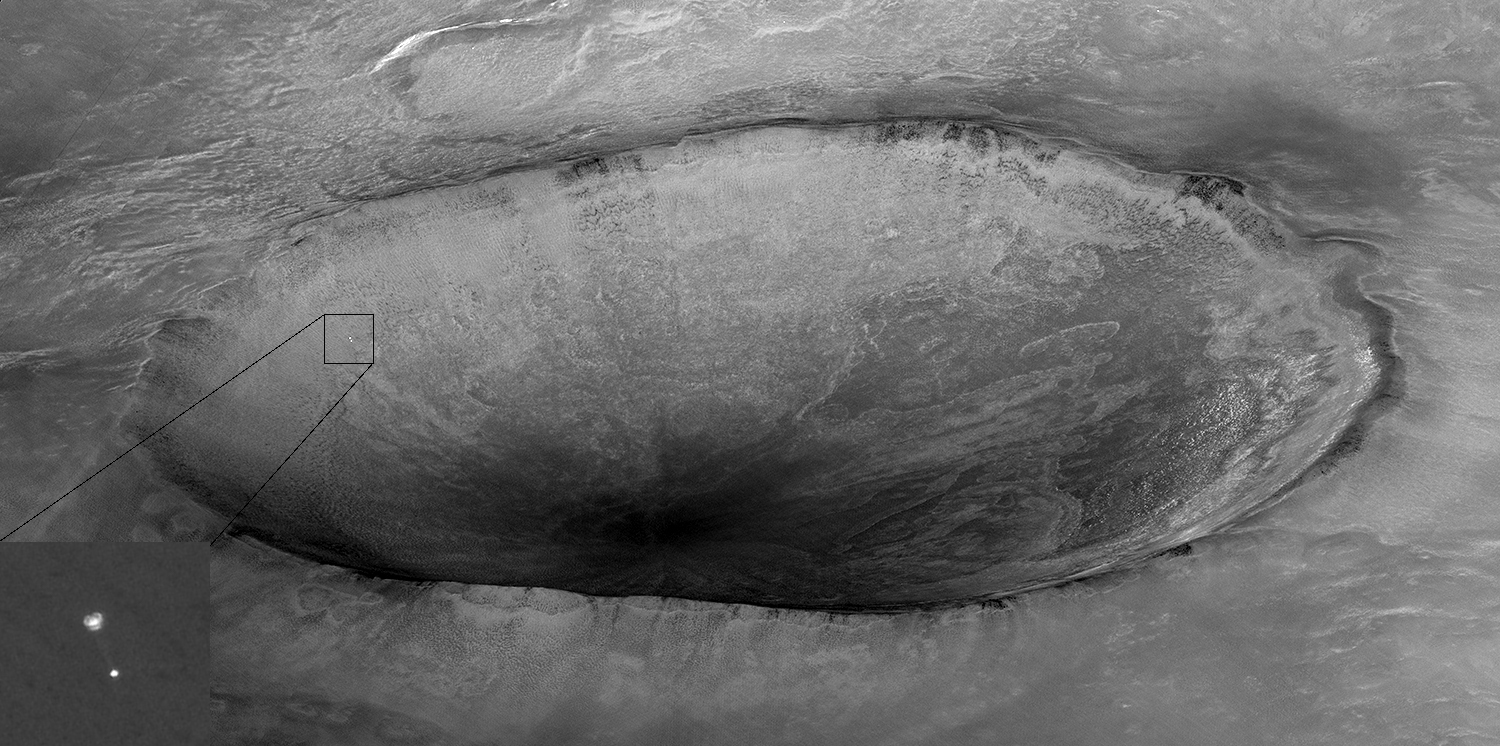
So by now I imagine everyone has seen the absolutely incredible picture of the Phoenix lander parachuting to the surface of Mars as caught by the HiRISE orbiter. Up until now I had only seen the close up, but while investigating the HiRISE site I was immediately greeted by the much larger picture.

On the left is the closeup, click on the image or the link above to see the wide view. It is thoroughly breathtaking.

Now in the blown up picture the lander looks like it's falling into the big crater named Heimdall that dominates the view, when in truth it's actually around 20 kilometers in front of it, landing on the nice flat ground!

I highly reccomend a browse of the HiRISE site if you've not been there already, it's full of the most amazing things you'll see for a while.

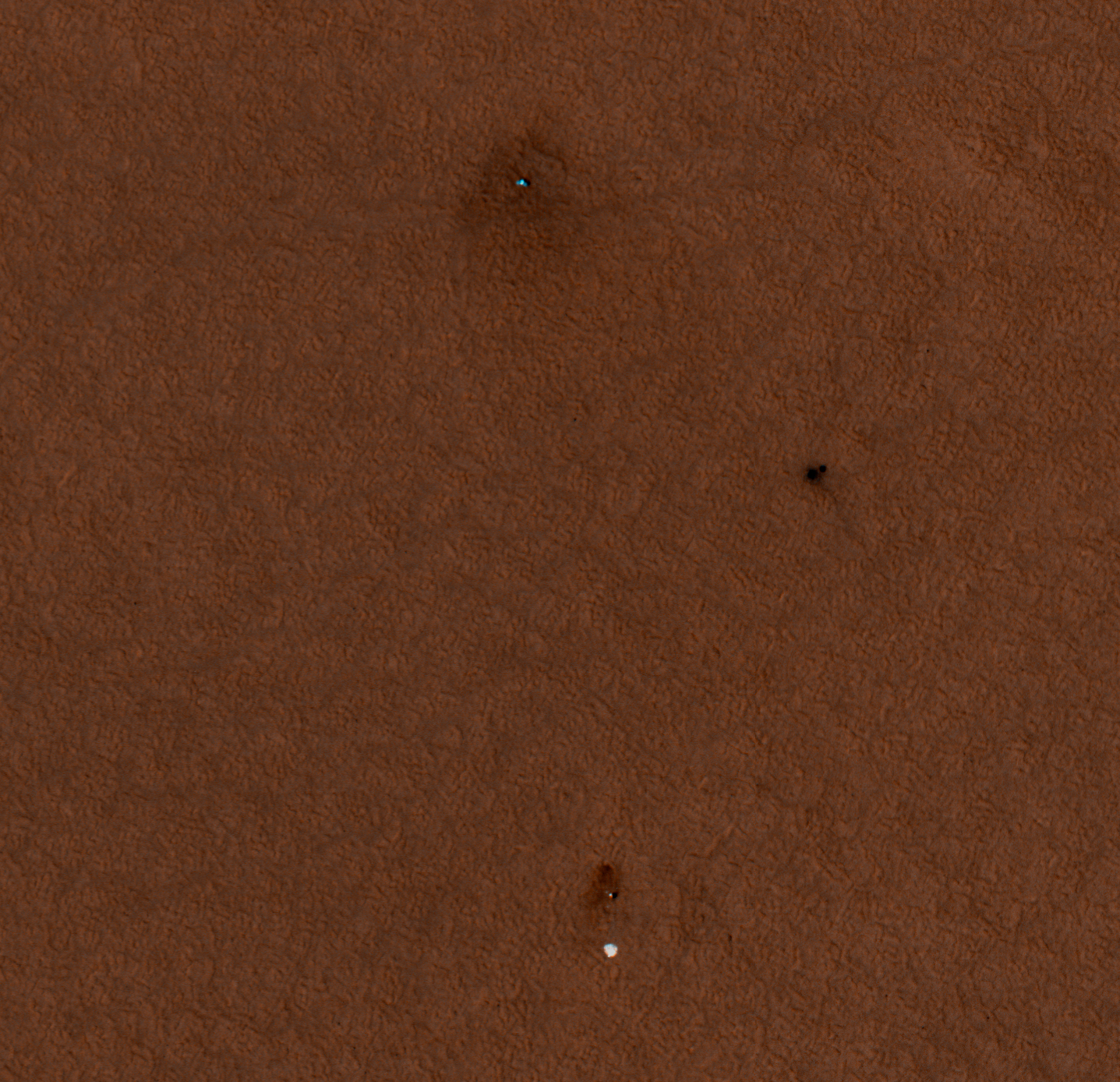
I can't exactly let this post go without also showing the image of the Phoenix lander on the surface too, so here you go!

Click the image for the bigger picture, also featuring the parachute, heatshield and other associated bits.

Monday, 26 May 2008

Pheonix Lander touches down on Mars

Unfortunately that's about as much info as the Phoenix mission page gives at the moment, but it's certainly great to know that another probe has successfully made the trip to Mars.


Hopefully we'll see some images from the surface fairly soon!

Edit: Short article on the landing up at the Nasa site.


Double edit: Pictures are up, and the probe looks in good shape. The flat plains around it might seem slightly featureless at first, but remember that this is the surface of another planet - and thus, is awesome. Enthusiasm aside however, there is most certainly a lot to be learned here!

Wednesday, 21 May 2008

Swift catches a Supernova in the act

In a bout of rather fantastic luck, Swift has managed to directly observe the initial x-ray flash of a supernova located in a distant galaxy . Usually by the time supernovae have been located they're already hours old, so this is one of those opportunities to get some new science done.

Bad Astronomy has a very well written page on it. Go, read, and enjoy!

Monday, 19 May 2008

Fun with Earth View

There are all sorts of applets out there that simulate astronomical viewpoints, most of which manage provide a reason to keep procrastinating that little bit longer. Having stumbled across one such thing earlier today, I thought I'd share it.

Earth View allows you to input your own data to gain views of the earth from varying distances, locations and levels of detail. The default setting has a nice night/day sim, lighting up population centres when dark so that they can be seen.

Nifty!

Sunday, 18 May 2008

Apod - The Origins of Gold

So gold, you see it all over the place, we make ornaments out of it, use it in expensive electrical devices, and hell, sometimes we even stick it in alcohol and drink the stuff. It's pretty and fairly valuable, but that ain't the half of it... you want awesome? Look at the circumstances surrounding its creation.

Now neutron rich elements such as gold are typically thought to be created in events such as supernovae, and usually that'd be more than cool enough, but it gets better. In our solar system the abundance of gold appears to be much higher than can be explained by conventional means, meaning that likely something else happened.

The answer it would appear, is that something along the lines of two neutron stars colliding could be responsible. In order to fully demonstrate how awesome this is I'd have to jump around making exploding noises and gesticulating lots. You're spared that for now, hopefully the mental image was enough.

Visit today's Astronomy Picture of the Day for the story.

Saturday, 17 May 2008

Devils on Mars

Though not of the sort the title may bring to mind, these are of a somewhat less fiery and more dusty variety.

Dust devils form when hot air close to ground level rises through an area of cooler low pressure air above, and are seen all over the world wherever there are flat plains and plenty of dust lying around. Considering Mars meets all the qualifications you may expect to see them there too right?

Right!

On Earth these whirling vortexes of air and dust are typically no larger than three feet in diameter, however on Mars they can be up to fifty times that, big enough even to provide a scare for the rovers currently wandering the surface of the planet.

Here (and in the above link) you can see a fantastic panorama taken from the landing site of one of the aforementioned rovers, and it quite noticeably features quite a few of our friends. I always think images such as these are particularly great as they really help to bring Mars to life, adding real dynamics to the still pictures we usually get back from our interplanetary voyagers.

Thursday, 15 May 2008

Venusian orbits

A few days ago ESA's Venus express probe completed its first two years orbiting our sister planet. Since then it has been revising and updating our knowledge of the planet, having already returned to us over 1200 Gig of data.

Among the most recent discoveries is the presence of the molecule Hydroxyl in the Venusian atmosphere. The molecule was detected by the Visible and Infrared Thermal Imaging Spectrometer about the craft at an altitude of around 100km from the planet's surface.

This is significant as it is highly reactive stuff, playing many important roles in the relative abundance of substances such as Ozone in atmospheres.

Full story on the ESA site.